Winter roof leaks
Ice Dam Ceiling Repair Around Fredonia, NY
For Fredonia houses, the ice dam ceiling repair season is late winter. Once a ridge of ice builds along the eave, meltwater stuck behind it can only travel one direction, back up beneath the shingles, and it usually comes through the ceiling a short distance inside an exterior wall.
From the room below, it shows as a brown ring, a crack along a taped joint or a spot that sinks under a fingertip. Replacing the board is ordinary drywall work. The care lies in confirming the framing and insulation are dry before anything gets closed in, and in stopping the mark from bleeding up through the new paint.
What should you do while the ceiling is still wet?
- Step one is the panel: kill the circuit feeding each ceiling light and fan within reach of the wet section. Next, herd everyone, pets included, away from the soggy area, and park a bucket beneath its lowest point.
- Where the panel is bowing, a small hole poked at its lowest point with a screwdriver lets the water drain into the pail on your terms, before the board gives way by itself. Do this only after the breaker is off.
- Carry furniture and electronics out, and take photos of the ceiling and of the eave from outdoors to keep on file.
- Stay off the roof. Climbing icy shingles or hacking at the dam with a hammer is the usual road to a fall and a split shingle.
Why does ice on the roof turn into a stain on the ceiling?
Western New York is among the places hit hardest by lake-effect snow, and the Fredonia and Portland station records an average of 24.5 inches in January alone. Through the coldest stretch the average high still edges above freezing while the average low dips below, so roof snow melts and refreezes time after time.
Warmth leaking up from heated rooms raises the temperature of the upper roof. Snow there melts, trickles down to the overhang, which hangs out over cold air, and freezes once more. The ice grows into a dam; the next batch of meltwater pools behind it and works upward under the shingles, through the roof deck, onto the attic insulation and the framing along the wall's top, and finally into the ceiling board.
- Snow over the warm upper roof melts from underneath.
- Meltwater refreezes at the cold eave and builds an ice dam.
- Water pooling behind the dam climbs beneath the shingle tabs.
- It drips through the roof deck onto the insulation and the top of the wall.
- The ceiling board soaks it up and a stain appears near the outside wall.
What does a dried-out leak mark look like up close?
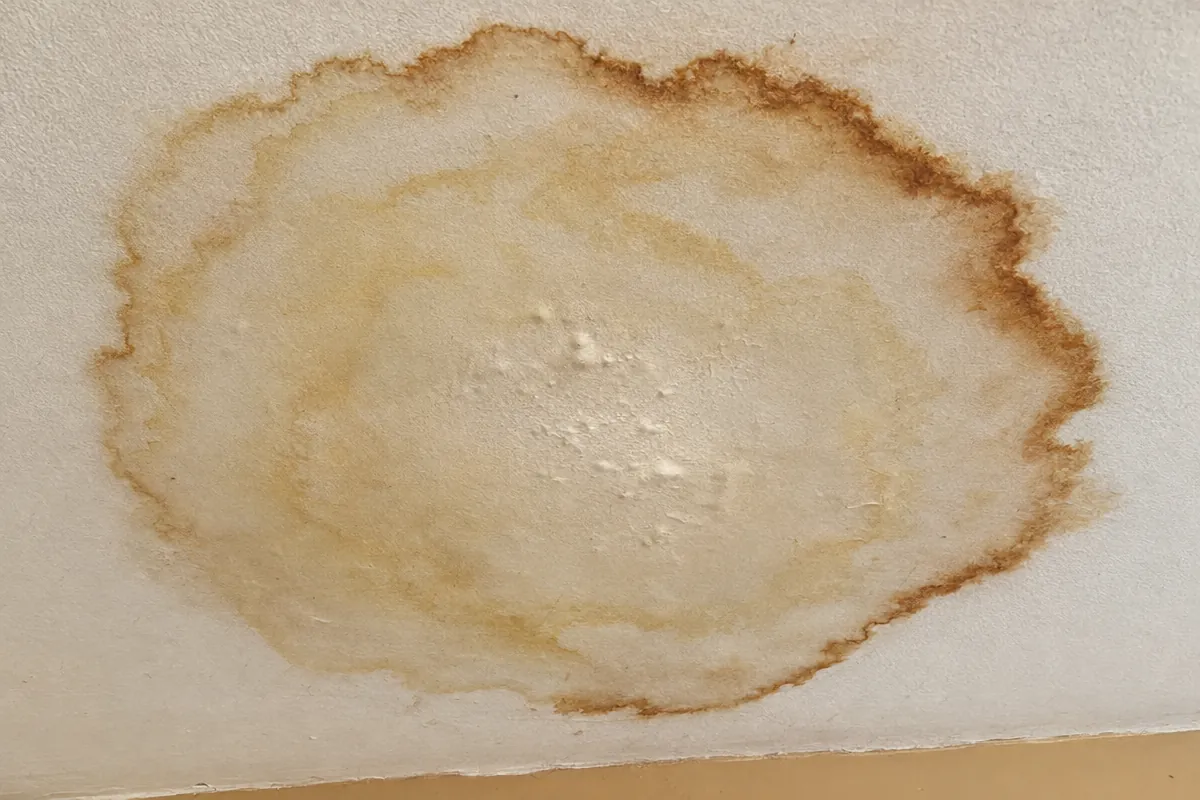
Rings like this one mean water got into the board and then dried out. The darker rim forms where minerals and wood tannins gathered as the moisture evaporated, which is why plain latex over the top tends to go brown again.
What does a proper ice-dam ceiling repair involve?
Metering the board
A moisture meter traces how far the water travelled past the visible ring. Board that dried firm can often stay; board that crumbles, droops or still reads damp is removed.
Looking above
Sodden attic insulation sitting over the mark keeps feeding moisture into the ceiling and has to be dried or swapped out, or the ring returns.
Replacing what failed
The failed area comes out joist to joist, a new half-inch ceiling panel fastened up, and the seams taped and coated.
Stain sealer over what stays
Any discolored board left in place gets a coat of stain-killing sealer, so the mark stays under the paint.
Blending the texture
Knockdown, orange peel or popcorn is reproduced over the patch and past its borders, then primed for paint.
Does the roof or attic need attention before the ceiling is fixed?
New board overhead only holds up if the dams stop forming. The root causes are usually warm air slipping into the attic, too little insulation and weak airflow at the eaves, which are jobs for the roofing and insulation trades. Booking that work ahead of the ceiling, or at least ahead of next winter, is the sensible order.
When the drip has quit and the snow has melted off, the ceiling can generally be repaired after the board and insulation dry. If water still comes through with each thaw, hold off.
For how the rest of the year treats a roof and the ceilings below it, read the guide to seasonal wall damage.
Still unsure about a stained ceiling?
Can the stained part be painted over instead of replaced?
Sometimes it can. If the gypsum is solid and dry, a sealer for stains under the topcoat often does the job. When it is soft, drooping or the paper has blistered, paint just disguises a weak spot.
What proves the ceiling has dried out?
Comparing a moisture-meter reading against a part of that ceiling that never got wet is the dependable test. Touch is not, because the face of the board can feel dry while its upper side stays damp.
Can the ceiling's texture be copied on the new board?
Closely, yes. Knockdown and orange peel get rehearsed on a spare offcut first, so blotch size and spacing look right before anything goes overhead.
Is it worth waiting until spring?
With sound board and a leak that has stopped, waiting for a dry spell does no harm. A bowing ceiling should not wait: kill the power to its fixtures, move everyone out from under it and call.